

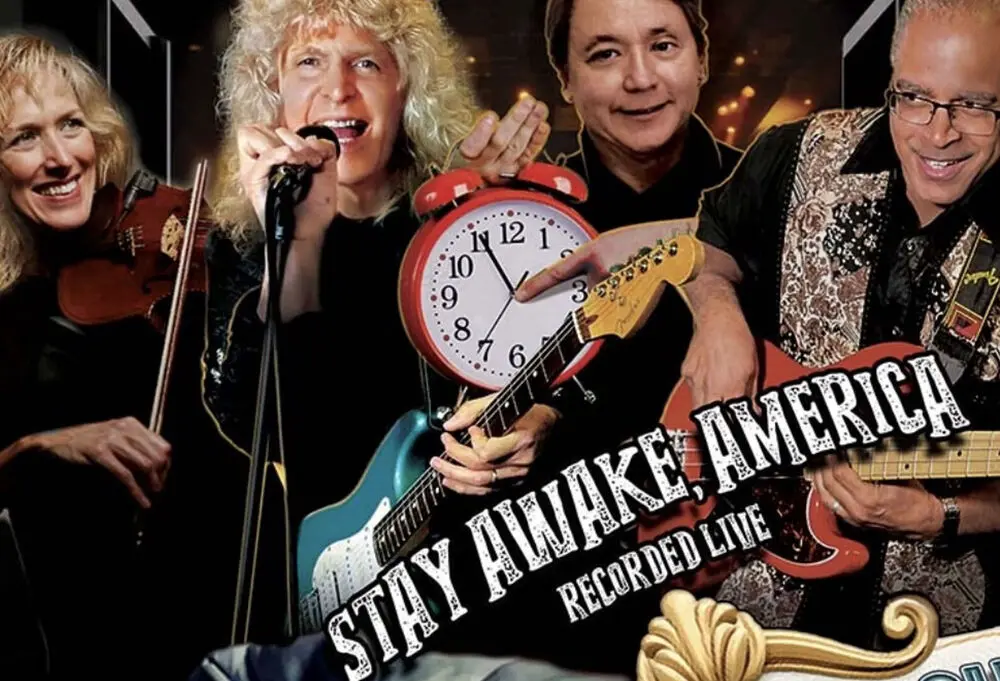
Interview with Caspar McCloud Band
Have you always been interested in music? What is your story and how did you start making music?
Yes, I have always been fascinated by music. In many ways, music found me before I was old enough to go looking for it. As a child growing up, melodies, harmonies and rhythms seemed like another language to me. The guitar soon became my voice—and, growing up in a society where we tend to suppress our emotions; music was considerably more expressive than I was permitted to be keeping a stiff upper lip and drinking British tea.
I began creating music because merely listening was never enough. I wanted to understand why one chord could awaken joy while another could make the heart ache for something deeper. I became rather obsessed with the guitar, and spent several years studying classical guitar, although rock music greatly attracted me. I was recognised as a musical prodigy, eventually moved to New York and signed with Atlantic Records. The legendary Ahmet Ertegun called me the “next Jimi Hendrix,” at my audition to sign with Atlantic, which was wonderfully encouraging and only somewhat intimidating!
However, I eventually discovered that applause is a poor substitute for peace. You can stand before an enthusiastic audience and still hear the emptiness within you between the notes.
My friend and mentor Phil Keaggy patiently shared the Gospel with me for seven years. During a personal crisis on an aeroplane, I finally surrendered my life to the Lord Jesus Christ. That changed everything. I realised that God had given me the gift long before I truly knew Him as the Giver of all that is good.
Creating art—whether it is music, painting, film or writing—is inherently transformative. Artists take their personal experiences and encounters and forge them into something tangible that may resonate with other people.
A friend once gave me a mug bearing the warning, “Be careful, or you may end up in my sermon.” That is not merely humour; it is also a fairly accurate description of the creative process!
Creativity works on several levels. The artist benefits through self-discovery and emotional expression, but the finished work may also transform the audience and, ultimately, influence society. One well-crafted song can alter our perception of reality in much the same way that one great idea can change the world.
God Almighty is the ultimate Artist, and one of the characteristics I find so appealing about Him is that He says what He means and means what He says. Every word has purpose, direction and meaning. We read in Deuteronomy 5:6:
“I am the LORD thy God, which brought thee out of the land of Egypt, from the house of bondage.”
That is direct, personal and liberating. God Almighty does not merely identify Himself; He reminds His people that He is the One who brings them out of bondage.
Scripture also reveals that God cares deeply about music—and that God Himself sings:
“The LORD thy God in the midst of thee is mighty; he will save, he will rejoice over thee with joy; he will rest in his love, he will joy over thee with singing.” — Zephaniah 3:17
Just imagine hearing the Creator of the universe singing over you. What must that sound like? What supernatural peace must be carried in the voice of the One who spoke creation into existence?
One thing I have learnt from studying what I often call our Holy Guide Book to the Supernatural is that God’s relationship with us is personal. When mothers and fathers sing over their babies, it is personal. When we sing over those we love, it is personal. Even when the Caspar McCloud Band performs before a large Stay Awake America audience, the same song may reach every individual on an entirely different level.
When God Almighty sings over His children, it must also be profoundly personal.
If God created music and chooses to sing, then music must be important to Him. That raises the question: What should we do with it? I believe the highest purpose of music is to glorify the Lord.
Consider the Last Supper, one of the most profound events recorded in Scripture. The Lord Jesus knew He was about to be betrayed, falsely accused, beaten and crucified. He knew that He would endure physical and emotional suffering beyond anything we can comprehend. He knew His mother would stand near the Cross with a broken heart, watching her Son—the promised Messiah—give His life.
He knew He was the sacrificial Passover Lamb who had come to bear the sins of the world. Yet, with all of that before Him, Jesus chose to worship the Father through music:
“And when they had sung an hymn, they went out into the mount of Olives.” — Mark 14:26
That is astonishing when we contemplate the depth of emotion the Lord must have experienced while anticipating what He would endure to save us.
As an artist and musician, I believe Jesus sang because music can express deep emotion in a way that spoken words alone cannot. Singing in worship helps us keep the Lord as our first love. It becomes a wholehearted declaration that we love and trust God, regardless of what may be happening in our lives.
Music actually predates humanity. In Job 38:7, the Lord speaks of the time “when the morning stars sang together, and all the sons of God shouted for joy.” The heavenly host was singing at the dawn of creation itself. Music is not merely a human invention; it is another wonder proceeding from the infinite creative mind of God.
I have spent much of my life, as have my bandmates, seeking to “play skilfully” unto the Lord, as Psalm 33:3 instructs us. Music is an art form, but it is also considerably more than we can fully comprehend on this side of Heaven.
My studies of Scripture, the mind-body connection and epigenetics—combined with my years as a recording artist—have convinced me that one carefully crafted song can change our perception of reality in much the same way that one powerful idea can change the world.
Music has an extraordinary ability to trigger memories, emotions and mental images. A melody can transport someone across decades in a matter of seconds. It can remind you of a person, a place, a season of life or an emotion you had almost forgotten. That is an astonishing amount of luggage for a few notes to carry!
Consider how David’s anointed music changed the spiritual atmosphere around King Saul. Scripture tells us that when David played, Saul was refreshed and the evil spirit departed from him. That causes me to consider what the Lord can accomplish through one genuine song of worship.
When we truly surrender ourselves to God in praise and connect with Him through the Holy Spirit, worship creates an atmosphere in which fear may depart, faith rises and hearts become receptive to the supernatural work of God Almighty.
Music transcends the intellect, the body and the ordinary senses. No one has ever managed to define it completely. A person born deaf may experience music through its vibrations, but how could we adequately explain the entire emotional and spiritual effect of music to someone who has never heard it?
Music can reach into places where no ordinary form of speech can fully travel. It can also draw out thoughts, emotions and spiritual longings that we never realised were living within us. I can sometimes communicate through a four-minute song what might otherwise require numerous hours of preaching and teaching.
One of our sayings on the Stay Awake America Tour is that our mission is to unite, engage and activate—because local action can bring about national and international impact.
Music helps us fulfil that mission. A song can cross social, cultural and political barriers that people may otherwise refuse to cross. It can present truth in a form that enters through the heart before the mind has time to erect another wall.
So my musical journey is ultimately a story of redemption. God Almighty took me as a young guitarist seeking recognition and transformed me into a musician seeking truth. I still enjoy making people marvel at what a guitar can do—but I would much rather help them discover what the Lord Jesus can do with a surrendered life.
The final purpose of my music is not simply to impress or entertain the listener. It is to glorify God, awaken hearts, encourage people to become overcomers and remind them to watch and pray.
As we continue fighting the good fight of faith, I pray that people will be blessed, strengthened and encouraged to overcome through the Lord Jesus Christ. We must remain prayerful and spiritually discerning as extraordinary events continue unfolding upon the world stage.
Never before has the technological infrastructure existed that could so rapidly produce the kind of global surveillance and control once confined to Orwellian fiction. Systems that previously might have taken generations to establish can now be assembled remarkably quickly. As in the days of Noah, the danger is not merely that darkness is increasing, but that so many people remain unaware of what is happening around them.
Yet our response must never be panic or to entertain the spirit of fear. It must be faith, wisdom, discernment and prayer.
“Watch ye therefore, and pray always, that ye may be accounted worthy to escape all these things that shall come to pass, and to stand before the Son of man.” — Luke 21:36
That is the heart behind our music and the Stay Awake America mission: stay awake, stand firm, become an overcomer and keep your spiritual eyes upon the Lord Jesus Christ.
What are you working on now? Any future releases we can look forward to?
At the moment, the Caspar McCloud Band is completing a new album entitled Metaphors and Dimensional Doors. I have always been fascinated by the way a metaphor can open the mind to a truth that ordinary language struggles to contain. Probably why the Lord Jesus spoke in parables so often, or maybe it was because they had so-called fact-checkers in his day too, who wanted to manipulate the truth. In that sense, a good song is itself a dimensional door: just by listening for a few minutes, it can transport you from where you are to somewhere you have never been—or perhaps somewhere your soul and spirit resonate with that your conscious mind had forgotten.
The album continues our exploration of faith, spiritual discernment, and the extraordinary times through which we are living, but it is also filled with divine hope. We never want merely to identify the darkness; we want to point people towards the Light. Naturally, there will also be plenty of guitar and violin as we embark on another musical adventure.
We are also discussing a sequel to the Stay Awake America rockumentary. The first film opened an important conversation about faith, freedom, culture, technology, and biblical prophecy. Since the world has shown no inclination to become less interesting, there is certainly more of the story to tell.
In addition, I have just delivered a new manuscript to my publisher. Writing books and writing songs use different instruments, but they share the same purpose: taking something unseen—a thought, revelation, or melody—and giving it a form that can be shared with others.
We are also considering additional Stay Awake America tour dates. Our desire remains to unite, engage, and activate people, because local action can produce national and international impact.
So there is a new album, another book, the possibility of another film, and more touring ahead. In fact, simply answering these interview questions is already giving me ideas for another song. Creativity is like inviting one musician into the studio and discovering he’s brought an entire band with him!
What Is Your Ultimate Goal In The Music Industry?
I have spent most of my adult life as a recording artist and musician, although I do not think of myself as merely performing. To perform can sometimes imply putting on a carefully manufactured personality for an audience. I prefer to think that I am sharing the gifts God entrusted to me. There is an important difference between drawing attention to yourself and using your gift to direct people towards something greater than yourself.
I have watched the music industry undergo enormous changes, and they have not all been beneficial. When I was young and signed to Atlantic Records, I was considered an up-and-coming pop musician—the sort of artist record companies would discover, develop and attempt to turn into a star through what sometimes resembled an assembly line.
The industry could take genuine individuality, polish it, package it and occasionally remove the very qualities that made the artist interesting in the first place. It was a peculiar business model: find someone unique and then persuade him to sound like whatever sold successfully last Tuesday!
Today, the machinery is different, but much of the philosophy remains. Record companies once looked for the next great artist; algorithms now look for the next few seconds capable of preventing someone from scrolling. Technology has given independent musicians extraordinary opportunities, yet it has also encouraged a culture in which music may be treated as disposable content rather than an enduring work of art.
A chart can measure transactions, but it cannot measure transformation. Streaming statistics may tell us how many people heard a song, but they cannot tell us whether that song gave someone courage, restored hope, awakened faith or persuaded a person not to surrender during the darkest night of their life.
That is why the response to our album Beyond Magnificent meant so much to us. UK Christian music reviewer Geoff Howlett gave the album a 10/10 rating, praising not only the music but the spiritual conviction invested by the entire band—Renae Truex on violin, Kenneth Ray Bentley on bass and Michael Adams on drums.
What especially delighted me was Geoff’s response to our song “Smiles,” which is about knowing and trusting a loving God through every storm and trial. He wrote, “This song, I instantly played again!”
To me, that is one of the finest compliments a songwriter can receive. A numerical rating is encouraging, but inspiring someone to stop and immediately listen again tells you that the song has reached beyond the ears and touched something deeper. You can read Geoff Howlett’s complete review of Beyond Magnificent here. https://neverfornothing.wordpress.com/2025/06/02/nfn-new-music-review-caspar-mccloud-band-beyond-magnificent-https-www-casparmccloudmusic-com/
Therefore, my ultimate goal is not simply to sell recordings, achieve recognition or occupy a position on a chart. I am grateful whenever those things help the music reach more people, but visibility is a vehicle, not the destination.
My goal is to honour the Lord Jesus Christ by creating music of genuine excellence—music that awakens people spiritually, encourages them to think deeply and helps them recognise that hope is still available. I want to write songs that are musically rewarding enough to invite repeated listening and spiritually substantial enough to reveal something new each time.
The Scriptures tell us:
“And whatsoever ye do, do it heartily, as to the Lord, and not unto men.” — Colossians 3:23
That is an excellent standard for any artist. If I am playing a guitar solo, writing a lyric or entering a studio, I should do it wholeheartedly—not merely for the approval of an audience, but as an offering unto God.
I also want to use whatever influence I have to encourage other artists not to surrender their identities to an industry that may view them primarily as products. God does not manufacture people on an assembly line. Every person bears His creative signature on every cell of their body, and genuine artistry should reveal individuality rather than erase it, as transhumanist are attempting to do.
With the Caspar McCloud Band and the Stay Awake America project, our desire is to unite, engage and activate people—because local action can bring about national and international impact. Music gives us a remarkable way to carry that message beyond the boundaries of an ordinary speech.
Ultimately, I want to leave behind more than a catalogue of recordings. I want to leave songs that continue speaking after the final note has faded—songs that strengthen faith, expose deception, comfort the broken-hearted and point people towards the Lord Jesus.
Awards eventually collect dust. Charts are replaced every week. Fame is remarkably temporary; eternity is not.
If one of our songs causes someone to press play again, encounter truth, rediscover hope or draw closer to Christ, then it has accomplished something no sales report could adequately measure.
That is not merely success in the music industry. To me, that is music fulfilling its highest purpose.
What Has Been The Biggest Challenge In Your Career Thus Far?
How have I been challenged? Let me count the ways—although we may need a considerably longer time to answer!
When people ask about the greatest challenge of my career, I do not think there is one isolated event. The deeper challenge has been learning how to remain faithful, creative and tender-hearted through disappointment, loss and an industry that continually changes its rules—usually just after you have learnt them.
James 1:2–4 tells us: “My brethren, count it all joy when ye fall into divers temptations; Knowing this, that the trying of your faith worketh patience. But let patience have her perfect work, that ye may be perfect and entire, wanting nothing.”
James does not tell us that every trial is joyful in itself. Pain is still pain, and loss is still loss. He tells us to count it as joy because we understand that God can accomplish something through it. The trial tests our faith, develops patience and produces spiritual maturity.
In other words, joy is not always our immediate emotional reaction; sometimes it is our deliberate spiritual calculation. We count the trial as joy because we trust the One who is able to redeem it.
One of the most difficult seasons of my life began early in 2026, when my beloved horse, Mr. Bob, passed away at twenty-eight years of age. I adopted him when he was only two, and we became as close as a man and horse can become.
For more than a quarter of a century, he was part of my life. He did not care whether a recording charted, how many people attended a concert or whether someone considered me a virtuoso guitarist. He simply knew me. There is something beautifully honest about the friendship of an animal: they are quite unimpressed by your résumé but remarkably attentive to your heart.
The day after Mr. Bob passed away, I wrote a song called “Losing You,” which will appear on our new album, Metaphors and Dimensional Doors. I did not sit down intending to manufacture a marketable song about grief. I was attempting to give language and melody to something my heart could not adequately express in conversation.
That is one of music’s most mysterious gifts. Sometimes we write a song, and sometimes it seems that the song is writing us—helping us process what has happened before our minds have fully understood it.
I have endured many difficult experiences, both personally and professionally, but losing Mr. Bob has made this one of the hardest seasons I have faced. Yet it has also reminded me that love always carries the risk of grief. We mourn deeply because we were privileged to love deeply. I would not trade those years of companionship merely to avoid the pain of saying goodbye.
Professionally, the music world has also become increasingly challenging. Since the turmoil of 2020—what I have often called the orchestrated and destructive “Covidmania”—life has changed in numerous ways. Many of my well-known musician friends have told me that the concert circuit is not nearly as plentiful as it once was.
Venues disappeared, touring costs increased, audiences changed their habits and much of the industry became even more dependent upon digital platforms and algorithms. Artists are now expected to be musicians, recording engineers, video producers, marketing departments and social-media personalities—often before breakfast.
The central challenge, however, is not simply surviving changes in the industry. It is refusing to allow those changes to dictate who you become.
It is possible to remain active while losing your purpose. It is possible to become so preoccupied with maintaining a career that you forget why you began making music. Success can test the soul as severely as failure because both tempt us to measure our value by circumstances rather than by our identity in Christ.
My greatest challenge has therefore been to keep creating without becoming cynical, to grieve without surrendering to despair and to adapt without compromising the message God has placed within me.
The Christian life does not promise that we shall avoid every storm. It promises that we shall never enter one without the Lord. Faith is not pretending that the storm does not hurt; faith is knowing that the storm does not have the final word.
When I listen to “Losing You,” I hear grief, but I also hear gratitude. I hear the testimony of twenty-six years shared with a magnificent animal who became part of my life and heart. If that song helps another person process the loss of someone—or some creature—they dearly loved, then the pain has been transformed into a bridge of compassion.
That is what artists are called to do: not merely display their wounds, but allow God to transform those wounds into windows through which light may reach someone else.
So the greatest challenge in my career has been perseverance—not simply continuing to work, but continuing to agape love, trust and create through seasons that might otherwise silence you.
The industry will continue changing. Concert circuits will expand and contract. Platforms will appear and disappear. Algorithms will eventually be replaced by newer algorithms designed to misunderstand us more efficiently.
But our calling remains.
We continue to fight the good fight of faith. We continue to play skilfully unto the Lord. We continue turning sorrow into songs, experience into wisdom, and trials into testimony.
If hardship produces patience, and patience is permitted to complete its work, then even our most painful seasons need not be wasted. In the hands of God, what felt like an ending may become the opening notes of something we could never have written any other way.
How do you go about writing a song? Do you have a melody in your head and then write the other music for it or what’s Your typical songwriting process?
My songwriting process is wonderfully consistent in one respect: it is almost never consistent!
Sometimes a melody arrives first. Sometimes it is a chord progression, a phrase, a rhythm or an observation that refuses to leave me alone. On other occasions, the lyrics and music appear together as though they had been acquainted for years and simply neglected to introduce themselves to me until I sit down and spend time with them.
I keep a guitar beside my desk in the office where I prepare sermons for The Upper Room Fellowship. That arrangement has proved both spiritually fruitful and mildly dangerous to deadlines because a sermon can suddenly become a song—and the song may then insist upon being included in an album everyone thought was already finished and ready to be released.
A few weeks ago, I was preparing a message about forgiveness. I was considering how we must forgive those who have wounded or offended us, even as Christ has forgiven us. Forgiveness does not mean pretending that the offence never occurred or declaring that evil was acceptable. It means refusing to allow another person’s behaviour to continue poisoning our inner life.
A spirit of bitterness wants to promises to protect us from being hurt again, but it actually keeps us emotionally chained to the person who hurt us. Forgiveness does not necessarily release the offender from every consequence; it releases us from carrying the offence everywhere we go.
I have written books examining thought life, health and epigenetics from a biblical perspective. Modern research increasingly recognises that prolonged stress, fear, resentment and destructive patterns of thought can profoundly affect the body. Yet Scripture instructed us to govern our thought life long before anyone constructed a laboratory in which to investigate it.
Second Corinthians 10:5 speaks of:
“Casting down imaginations, and every high thing that exalteth itself against the knowledge of God, and bringing into captivity every thought to the obedience of Christ.”
That is not merely poetic theology; it is remarkably practical instruction. Thoughts produce emotions, emotions influence choices, repeated choices become habits, and habits can eventually shape the direction—and even affect the health—of a life. We must learn to examine a thought before allowing it to become a permanent resident. Not every thought arriving at the door of your mind deserves a room and breakfast.
While preparing that sermon, I reached for the guitar beside my desk. I was not consciously attempting to write a song; I was simply contemplating what I planned to preach that Sunday. I began playing a progression in D minor, and almost immediately the words began to form:
“Before my feet touch the ground,
I’m so grateful to wake up here,
And lay it all down—
Every hurt I’ve carried around.”
The central idea was to begin each day by bringing every wound, disappointment and painful word before the Lord—before our feet even touch the floor and before yesterday’s poison has an opportunity to enter today.
The next lines came:
“I lay it all on Your altar,
Where its poisons cannot spread.
I will not allow a spirit of bitterness
To follow me into this day.”
Within about fifteen minutes, most of the song was there. Those moments are difficult to explain because you are working, but you are also receiving. Craft and inspiration meet one another. Years of learning the instrument give you the vocabulary, but the Holy Spirit can breathe upon that vocabulary and cause it to say something you had not planned saying.
The prayer at the heart of the song became:
“Help me, Lord my Saviour,
In my unbelief.
Forgive me as I forgive,
And change my behaviour.”
I especially like that final thought because genuine forgiveness is not merely something we say; it changes how we behave. It affects what we rehearse in our minds, what we speak and how we respond when the memory returns.
As soon as I had written the song, I made a simple recording so I would not forget it. That is another essential part of my process. Inspiration can be rather like a visiting bird: if you do not capture the melody when it lands, it may fly away and perch in someone else’s song!
I originally thought I would simply play it for the church alongside the sermon. I performed it that Sunday and recorded a video, and it was received extraordinarily well. People connected with its vulnerability and with the practical idea of beginning the day by laying every offence upon God’s altar.
I played it for my musical twin, Renae Truex before I played it for anyone. Renae possesses an instinctive understanding of where a song wants to go. We recorded it together for our forthcoming album, Metaphors and Dimensional Doors, because it seemed to belong there. It provides a quiet, contemplative moment between some of our more energetic rock songs. We are all such rockers at heart.
Our band and our engineer and producer have now learnt to expect me to arrive with another song just as we are completing an album. Apparently, “final track listing” is not so much a decision in our world as a theological hypothesis! The Holy Spirit is not obliged to observe recording deadlines.
Once I bring a song to Renae, Kenneth Ray Bentley and Michael Adams, it begins another stage of its life. Renae may discover a violin line that expresses what the lyric cannot say. Kenneth finds the movement and foundation within the bass, while Michael gives the song its pulse and architecture through the drums. A song may begin privately beside my desk, but the band helps it become something larger than my original sketch.
So my typical process is to remain spiritually and creatively attentive. I listen for a phrase, a question, a chord or an emotion that contains more than it first appears to contain. Then I follow it.
Technical skill matters enormously. We are told in Psalm 33:3 to “play skilfully.” But technique alone cannot give a song life. Technique constructs the vessel; inspiration fills it.
“Before My Feet Touch the Ground” began as a sermon about forgiveness, became a prayer with a melody and then grew into a recording with my musical family. That is often how songwriting works for me: biblical truth enters the heart, experience gives it emotional weight, music gives it wings, and the band helps it fly.
How do you feel the Internet has impacted the music business?
The Internet has transformed the music business in ways that are both wonderfully liberating and slightly bewildering.
Its greatest contribution is that artists can now communicate directly with their audiences. We can share a song, video or message without first obtaining permission from a committee of executives who may understand quarterly projections better than music. The Internet allows artists to find their audience—or, as people often say today, to find their tribe.
When I was starting out, one of my mates at art school was friends with Peter Gabriel. My friend told Peter that I was the finest guitarist he had ever heard. We were still in our late teens, so I am not entirely certain how many guitarists he had heard by that point—but I remain grateful for his enthusiasm!
Peter was extraordinarily kind towards me. I visited him a number of times at his home near Bath, England, not far from Solsbury Hill, about which he later wrote that rather memorable song, as well as being invited back stage at some of his concerts.
Peter was the first established musician to convince me that I should make a professional demo tape. He took it to his record company and personally attempted to help me secure a recording contract. I have never forgotten his generosity.
Peter was also a visionary creator. Long before the Internet became part of everyday life, he spoke about a future in which artists would have greater control over their own music. At the time, the record companies controlled almost everything: recording studios, manufacturing, distribution, radio promotion and access to the marketplace.
Making a professional recording was enormously expensive. Studio time cost a small fortune, tape had to be physically manufactured, artwork printed and finished records transported to shops. Even if you possessed tremendous talent, reaching an audience generally required the machinery of a record company.
Peter understood that technology would eventually transfer much of that power back to the artist. In many respects, his prediction proved correct.
Today, musicians can record an album in a home studio, distribute it throughout the world and communicate directly with listeners across several continents—all without leaving the room. A song created in Georgia can be heard in England, Australia or South Africa minutes after it is released.
That is extraordinary. The Internet removed many of the old gatekeepers and lowered the drawbridge. Unfortunately, once the drawbridge came down, several million musicians attempted to cross it simultaneously!
Because recording and distribution have become accessible, the market is now flooded with music. Some of it is magnificent, some is promising, and some demonstrates that owning recording software is not precisely the same thing as knowing how to make a record.
Accessibility democratised music, but democracy does not automatically guarantee excellence. Technology can correct the pitch, adjust the timing and imitate almost any instrument, but it cannot manufacture spiritual substance. It may help someone produce a polished recording, but polish and profundity are not the same thing.
The old system had gatekeepers who could prevent talented people from being heard. The new system has algorithms that may bury them beneath an ocean of content. We escaped one set of gatekeepers only to discover that the new ones are invisible, mathematical and apparently fascinated by dancing cats.
There is also an economic contradiction. Music has never been more widely available, yet it has become increasingly difficult for many musicians to earn a sustainable living from recordings. Listeners now have almost the entire history of recorded music in their pockets, but that convenience can cause an individual song to seem disposable.
When someone purchased an album, they often sat with it, examined the cover, read the lyrics and listened repeatedly. Today, a listener may decide the fate of a song within the first few seconds. We have nearly unlimited access to music but increasingly limited attention with which to receive it.
Nevertheless, I remain grateful for the opportunities the Internet provides. It allows the Caspar McCloud Band to communicate directly with people who connect with our music and the Stay Awake America message. We can release songs, share performances, announce tours and engage with listeners without waiting for someone in an office to decide whether our message fits the current commercial fashion.
It also enables artists to build genuine communities rather than merely accumulate consumers. There is an important difference between having followers and having fellowship. Numbers may look impressive on a screen, but meaningful communication occurs when music creates a real connection between human beings.
The Internet is ultimately an amplifier. It can amplify truth or deception, excellence or mediocrity, wisdom or foolishness. It has given artists more freedom, but freedom always brings greater responsibility. If we can reach the world directly, we must consider carefully what we are sending into it.
Peter Gabriel foresaw artists gaining control over their work, and he was right. Yet control is not the same as purpose. The essential question is no longer merely, “Can I release this?” Almost anyone can. The more important questions are, “Should I release it? Does it communicate something worthwhile? Will it add light or simply add noise?”
For me, the Internet is most valuable when it helps a meaningful song find the person who genuinely needs to hear it. If technology enables us to bypass geographical boundaries, connect with our tribe and point people towards truth, hope and the Lord Jesus Christ, then it has served a worthy purpose.
The Internet has placed a global broadcasting station into the hands of almost every artist. Now we must possess the wisdom to decide what is worth broadcasting.
There is another fascinating connection between the Internet and CERN that deserves careful consideration. British scientist Sir Tim Berners-Lee invented the World Wide Web—not the Internet itself—while working at CERN in 1989. It was originally designed to help scientists share information, but it ultimately transformed civilisation.
That raises a larger question: Could CERN represent a modern technological echo of the ancient Tower of Babel?
The people of Babel united around human ambition and attempted to reach into the heavens independently of God. The essential sin was not architecture; it was humanity using its collective intelligence to exalt itself and transcend the boundaries established by its Creator.
CERN officially describes its work as investigating the fundamental structure of matter. Its experiments include searches for evidence of extra dimensions, dark matter and previously unknown particles. However, CERN does not officially claim that it is opening dimensional gateways through which beings might enter or depart. Searching scientifically for evidence of extra dimensions is not the same as opening a supernatural portal, and we should be careful not to present speculation as established fact.
Nevertheless, Christians are entitled—and, I believe, obligated—to examine the spiritual philosophy accompanying humanity’s pursuit of unlimited technological power. Scientific ability does not automatically confer moral wisdom. The question is not only, “What can we do?” but also, “What should we do, and whose authority are we acknowledging?”
I remain concerned that CERN’s experiments may eventually prove relevant to the extraordinary events described in Revelation 9, including the opening of the bottomless pit. I present that as a prophetic interpretation, not as a scientifically demonstrated conclusion. Whether that interpretation proves correct or not, Revelation warns us that spiritual realities exist beyond the narrow limits of ordinary human perception.
We must therefore avoid two equal and opposite errors: blindly trusting everything performed in the name of scientific advancement, or carelessly claiming evidence that does not exist. True discernment requires us to investigate diligently, speak accurately and remain spiritually watchful.
Humanity is again constructing systems capable of uniting the world technologically, economically and politically. The tools themselves may appear neutral, but in the hands of unaccountable powers they could help establish the centralised global control anticipated in biblical prophecy.
CERN may or may not become directly involved in the fulfilment of Revelation 9 during our lifetime. Yet its pursuit of realities beyond currently observable dimensions should remind every believer that the physical world is not the whole of reality.
The Tower of Babel teaches us that when technological unity is separated from submission to God, human progress can become organised rebellion. Revelation teaches us that doors should not be opened merely because humanity has discovered how to approach them.
We must continue watching, praying and testing every claim against both credible evidence and the Word of God. The more powerful our technology becomes, the more urgently we require humility, moral restraint and spiritual discernment.
List some famous musicians currently on your playlist?
My playlist is rather eclectic. It may move from Johann Sebastian Bach to my mentor Phil Keaggy without requesting anyone’s permission in between.
Bach is credited with saying, “The final aim and reason of all music is nothing other than the glorification of God and the refreshment of the spirit.” That is one of the finest definitions of music I have encountered. Bach possessed extraordinary technical genius, yet he understood that musical excellence should serve a purpose greater than displaying the brilliance of the musician.
I listen to Bach because his music contains architecture, mathematics, emotion and worship simultaneously. Every musical line seems to possess intelligence, yet the whole composition points beyond itself. Handel has a similar effect upon me—particularly when sacred truth is expressed with such musical majesty.
Ludwig van Beethoven also belongs on my playlist. The statement “Music can change the world” is often attributed to him, and whether or not those were his exact words, his life and music certainly embodied that conviction. Beethoven understood music as a transformative force capable of transcending circumstances, stirring courage and communicating what ordinary language cannot contain.
His achievements become even more extraordinary when we remember that he continued composing while losing his hearing. That is not simply musical genius; it is a profound demonstration that physical limitations need not silence the music God has placed within the human spirit.
Among guitarists, my friend and mentor Phil Keaggy will always have a place on my playlist. Phil is one of those rare musicians whose technical ability never overwhelms the heart of the music. His playing can be astonishingly complex yet remain deeply intimate and worshipful.
I still enjoy listening at time to guitarist like Jimi Hendrix because he altered our understanding of what an electric guitar could do. He did not merely play the instrument; he seemed to negotiate with it, occasionally argue with it and ultimately persuade it to enter another dimension.
Another wonderful musical memory concerns my old bassist, Matt Bissonette. Matt and I played in a band together during my Atlantic Records years, but we had not seen one another since I left the label. Many years later, I happened to encounter him when he was performing with G3.
The moment Matt saw me, he smiled and said, “If I had only known you were here, it could have been a G4 concert!”
That remains one of my favourite compliments—and certainly one of the most efficient promotions I never received. Moments like that remind me how genuine musical friendships can survive decades apart. You may travel along entirely different roads, but when you meet again, the conversation resumes as naturally as returning to the chorus of a familiar song. Matt and I have kept in touch since then.
Last weekend I played in Wisconsin at Guitar Masters 3.0 with Glenn Kaiser and Todd Moyer, which seemed like a Christian spin off of G3.
The Beatles remain important because of their melodic imagination and constant creative development. Their recordings demonstrate how memorable songwriting and studio experimentation can work together without sacrificing accessibility.
Peter Gabriel is another visionary artist I admire. I knew Peter when we were young, and he was extraordinarily kind to me. He encouraged me to make a professional demo and personally took it to his record company. His music reflects the same imagination and willingness to explore that I recognised in him all those years ago.
Yes has also been a significant musical inspiration. Their compositions combined virtuosity, imagination and a willingness to venture far beyond the predictable boundaries of conventional rock music.
One day, Ahmet Ertegun called me into his office at Atlantic Records. He explained that Steve Howe was not planning to continue with Yes and told me that I was his leading candidate to replace him. I said that I would have loved to play with Yes, but my managers advised against it.
Had that decision gone differently, I might possibly have become part of the musical journey that eventually produced 90125 and “Owner of a Lonely Heart.” Instead, Trevor Rabin joined the re-formed Yes and helped redefine their sound on that enormously successful album.
Life contains a number of fascinating doors we might have entered. Occasionally, one looks back and wonders what music might have been waiting on the other side. Still, I trust that the Lord can direct us even through decisions that appear mysterious in retrospect.
I have also appreciated Rick Wakeman—not only as an extraordinary keyboardist, but as someone who has spoken openly about his Christian faith and remained actively connected with church life. His journey is another reminder that exceptional musicianship and sincere spiritual faith need not occupy separate worlds.
Tommy James is naturally high on the list as well. Tommy possesses an exceptional instinct for melody and for recognising what makes a song communicate immediately. Having performed as a Shondell and written songs with Tommy, I have witnessed that gift at close range.
My playlist therefore includes Bach, Handel, Beethoven, Phil Keaggy, Jimi Hendrix, the Beatles, Peter Gabriel, Yes, Rick Wakeman and Tommy James—along with numerous other artists whose work contains genuine melody, originality and emotional truth.
I also spend a considerable amount of time listening to unfinished Caspar McCloud Band recordings. That may sound rather self-absorbed, but somebody must decide whether the guitar needs to be louder. Curiously, most guitarist usually believes that it does!
I do not listen only for style or technical ability. I listen for the moment when craftsmanship becomes communication—when musicians stop merely demonstrating what they can do and begin revealing something meaningful.
Music can transform an individual heart, and transformed hearts can influence families, communities and nations. That is one reason music remains central to our Stay Awake America mission: a song can carry truth across barriers that an ordinary speech may never penetrate.
The finest music refreshes the spirit, awakens the imagination and leaves us hearing the world differently. Bach was right about its ultimate purpose, and Beethoven’s example confirms its transformative power: music reaches its highest calling when it glorifies God, strengthens the human spirit and helps change the world.
What Did You Do Before You Started Making Music?
That question assumes there was a time before I started making music, and I am not entirely convinced there was!
I was apparently rocking even as a baby in a stroller. Being English, I should properly say “pram,” but “rocking in a stroller” sounds considerably better in a musical biography. Besides, no respectable rock song has ever begun with, “There I was in my pram.”
From a very early age, my world revolved around three great loves: music, art and horses. Books soon joined them, although books required considerably less feeding and almost never stood on my foot.
I spent many hours studying the paintings of the Pre-Raphaelites. I was fascinated by their extraordinary detail, luminous colours, symbolism and ability to tell an entire story within a single image. They understood that beauty could carry meaning—that something visually magnificent could also contain layers of moral, emotional and spiritual significance.
That way of seeing eventually influenced my music and songwriting. I have never wanted merely to create something attractive on the surface. Whether I am painting a portrait, writing a book or composing a song, I want the work to contain details and meanings that reward someone for looking—or listening—more closely.
Horses were equally important to me. When I was young, I would clean as many as fifty stalls simply for the privilege of riding. That is an excellent education in humility because horses are entirely unimpressed by artistic ambition. Before you can experience the freedom of galloping across a field, somebody must attend to the stable.
Horses taught me patience, responsibility and non-verbal communication. A horse notices what is happening within you long before you have found sufficiently impressive language to conceal it. You may attempt to persuade people that you are perfectly calm, but a horse has already read the footnotes.
I have often thought the world would be considerably more stable if everyone still rode horses. We might move more slowly, but perhaps we would arrive with better character.
I also read constantly. Books allowed me to travel across history, theology, science, philosophy and imagination without requiring a passport. Reading trained me to recognise connections between subjects that are often treated as separate—the spiritual and physical, creativity and reason, music and mathematics, thought and health.
For a brief period, I attempted medical school. In retrospect, I realised that I was there largely because my girlfriend at the time, who came from New Zealand, was a medical intern. She was pursuing medicine with genuine purpose; I was pursuing her while quietly wishing to play guitar in a rock band.
Eventually, honesty prevailed. I recognised that I did not truly want to practise medicine—I wanted to make music. The medical profession did not lose a great doctor, but rock music gained a determined guitarist.
Still, that brief encounter with medicine was not wasted. My continuing interest in the relationship between the mind, body and spirit later became important in my books and ministry, particularly my study of thought life, stress, faith, healing, and epigenetics. God has an extraordinary way of redeeming even the roads we briefly travel before discovering they are not our destination.
So before music became my profession, I was already gathering the raw materials that would eventually shape it: the beauty and symbolism of Pre-Raphaelite art, the discipline and sensitivity learnt from horses, the ideas discovered in books and the questions awakened through medicine.
In that sense, I was not doing something entirely different before I began making music. I was learning how to observe, how to feel, how to think and how to communicate.
The guitar simply became the instrument through which all those worlds finally learnt to speak to one another.
Would you have any advice for young people wanting to follow in your footsteps?
My first piece of advice would be: please do not follow too closely in my footsteps, because some of them went through horse stalls!
More seriously, the Apostle Paul wrote:
“Be ye followers of me, even as I also am of Christ.” — 1 Corinthians 11:1
That verse establishes an essential qualification. We should follow someone’s example only to the degree that their example follows Christ. So I would encourage young people to learn from my journey—including my successes, mistakes and occasional spectacular detours—but ultimately to keep their eyes upon the Lord Jesus.
Do not attempt to become another Caspar McCloud, Phil Keaggy, Jimi Hendrix or anyone else. God has already created those people, and He is remarkably economical about originals. Learn from other artists, but allow the Lord to establish the path uniquely prepared for you.
A genuine mentor should never produce a copy of himself. He or she should help you recognise, develop and steward the distinctive gifts God placed within you. Follow faithful examples, but follow Christ above everyone.
The music industry will continually tell young artists what they should sound like, how they should look and which trends they must follow. Trends, however, are usually exhausted by the time everyone recognises them. If you spend your life chasing what is fashionable, you will always arrive just as fashion is leaving through another door.
Discover your own voice.
You may be influenced by great musicians, but influence should become nourishment rather than impersonation. Study what made those artists exceptional, then allow it to pass through your own experiences, convictions and imagination. Phil Keaggy encouraged me tremendously, but he never instructed me to become another Phil Keaggy. He helped me understand how to become more completely the person and musician God intended me to be.
Secondly, master your craft. Inspiration is glorious, but inspiration tends to cooperate more readily with preparation. Practise until your fingers can obey what your imagination hears. Learn rhythm, harmony, melody, dynamics and arrangement. Listen to music outside your preferred style. Read books. Study art. Observe people. Spend time in nature. A songwriter who knows only music may eventually discover that he has nothing particularly interesting to write about.
Psalm 33:3 says:
“Sing unto him a new song; play skilfully with a loud noise.”
Notice that Scripture joins the new song with skilful playing. The anointing is not an excuse for laziness. If the Lord has entrusted you with a gift, developing that gift is an act of stewardship.
At the same time, never mistake technical brilliance for meaningful communication. You can play a thousand notes and still say absolutely nothing. Music is not an athletic competition with amplifiers. Technique should serve the song, and the song should serve the truth you are attempting to communicate.
Protect your character as diligently as you develop your talent. Talent may open a door, but character determines what you do after entering the room. The industry contains many gifted people who became successful before they became wise enough to manage success.
Be careful whom you trust. Learn how contracts, publishing rights, royalties and ownership work. Never sign something merely because someone places an impressive logo at the top of the page and calls you “the next great star.” Compliments are encouraging, but they are not legal counsel.
Surround yourself with people who are willing to tell you the truth. Anyone who agrees with everything you say is not necessarily loyal; they may simply be waiting for access to whatever your gift can provide. A faithful friend may occasionally irritate you by preventing a very expensive mistake.
I would also advise young artists not to confuse visibility with value. Social-media followers are not the same thing as following God’s purpose. An algorithm may reward something superficial while ignoring something profound. The number beside a video cannot tell you whether your song helped someone survive a night of despair.
Use the Internet, but do not allow it to use you. Let technology distribute your work without permitting it to define your worth. Platforms change, trends disappear and today’s viral sensation may become tomorrow’s answer to a trivia question.
Learn to receive rejection without allowing it to become your identity. Every artist will hear “no.” Sometimes “no” means you must improve. Sometimes it means you have approached the wrong person. Sometimes it is God’s protection. Discernment is learning the difference.
When I was young, I thought arriving at a major record label meant that I had reached the destination. I later discovered it was merely another road—and occasionally a road with very expensive tolls.
Success cannot heal what is broken within you. Applause sounds wonderful, but it fades quickly, and eventually you must return home with the person you have become.
That is why your private life matters more than your public image. Do not build a stage personality that your soul cannot survive. Remain the same person when the spotlight is switched off.
Serve people rather than merely trying to impress them. Ask yourself: What does this song contribute? Does it encourage, awaken, comfort or challenge? Is it adding light, or merely adding noise?
Never despise small beginnings. Play for ten people with the same integrity you would bring before ten thousand. Every person in that small audience carries an entire world of experiences, wounds and possibilities. If your song genuinely reaches one heart, something eternally significant may have happened.
Remain teachable. You may be gifted, but no one is so gifted that they have nothing left to learn. I have spent most of my life playing guitar, and I still discover new ideas within six strings. Mastery is not reaching the end of learning; it is becoming increasingly aware of how much remains undiscovered.
Be willing to work when no one is applauding. Much of what people eventually call “talent” is the visible result of years spent practising in private. They see the performance but not the repetition, discipline, frustration and perseverance that made the performance possible.
Do not fear mistakes. A wrong note is not the end of civilisation, although certain guitarists have attempted to make it sound like one. Learn from it and keep playing. Perfectionism can become procrastination wearing respectable clothing.
Most importantly, keep your relationship with God above your ambition. Your gift is something you possess; it is not who you are. If your identity depends upon success, every disappointing review will feel like a verdict upon your existence.
When your identity is established in Christ, however, you can receive praise without becoming intoxicated and criticism without being destroyed. You can remain grateful when doors open and faithful when they close.
My advice is therefore quite simple: pray deeply, study widely, practise faithfully, live honourably, read every contract and never surrender the distinctive voice God placed within you.
Do not merely ask how to become famous. Ask how to become faithful.
Fame may allow people to recognise your name for a season. Faithfulness enables your life and music to carry meaning long after the final applause has faded.
Follow worthy examples as they follow Christ—but keep the Lord Jesus as the ultimate pattern, purpose and destination of your life.
If you could change anything about the music industry, what would it be?
If I could change one thing about the music industry, I would remove the corruption and moral darkness that have too often been embedded within its machinery.
That does not mean everyone in the industry is corrupt. I have encountered some extraordinarily generous, honourable and compassionate people. However, I have also watched a business built upon beautiful music become disfigured by exploitation, manipulation, greed and the worship of celebrity.
The fundamental problem is that the industry can begin treating human beings as products. Young artists arrive with talent, hope and very little understanding of contracts. They may be surrounded by people who praise them extravagantly while quietly calculating how much can be extracted from their gifts.
The artist is told, “We believe in you,” when the contract occasionally means, “We believe we can own you.”
When I was beginning my career, I came very close to signing with Virgin Records through Sir Richard Branson. At that time, it appeared to be another possible door into the future. Decades later, recently released Epstein-related documents and reported correspondence have raised troubling questions about Branson’s social contact with Jeffrey Epstein. Branson’s representatives have said that he was unaware of Epstein’s criminal conduct at the time and condemned it as abhorrent. Being named in documents or having contact with someone does not, by itself, prove participation in that person’s crimes, so this subject must be discussed accurately and responsibly.
Nevertheless, such revelations remind us how frequently powerful industries overlap with networks of wealth, influence and secrecy. Fame and fortune should never place anyone beyond moral accountability. The greater a person’s power, the greater the responsibility to exercise discernment concerning the company they keep and the systems they support.
If I could reform the industry, I would expose exploitation wherever it exists. I would protect young artists from predatory contracts, sexual coercion, financial manipulation and powerful individuals who use promises of opportunity to demand moral compromise.
No one should be required to surrender their conscience in order to share their gift.
I would also ensure that artists properly understand and retain meaningful ownership of their recordings, songs and publishing. Too many musicians discover that they created the work, performed the work and promoted the work, yet somehow someone in an office owns the work.
I would make royalty systems transparent. Artists should not require a forensic accountant, a private investigator and the wisdom of Solomon merely to discover whether they have been paid correctly.
I would also challenge the industry’s tendency to reward image above substance. Music should not be reduced to appearance, controversy or marketability. A young artist should not be pressured to become increasingly shocking simply because an executive believes moral decline is an effective promotional strategy.
Yet I also want to honour the truly good people I encountered.
Harry Belafonte treated me with extraordinary kindness. After hearing me play, Harry invited me to record on his soundtrack for Beat Street. My engineer was Gene Paul, the son of the legendary Les Paul. When recording sessions continued late into the evening, Harry would arrange for his chauffeur to drive me safely home.
That may appear to be a small gesture from someone so successful, but kindness is never small to the person receiving it. Harry treated me as a young musician worthy of care rather than merely another useful pair of hands in the studio.
Gene Simmons from KISS was also kind and fatherly towards me when I was starting out. Experiences like those are important because they demonstrate that success does not inevitably corrupt someone. A person can possess influence and still choose generosity. Power reveals character; it does not have to destroy it.
The contrast taught me something significant. The music industry is not simply divided between famous people and unknown people, or successful artists and struggling artists. The more meaningful division is between those who use influence to serve others and those who use people to serve their own influence.
If I could change the industry, I would establish a culture in which talent is nurtured without being exploited, contracts are understandable, ownership is respected and young musicians are protected rather than preyed upon.
I would want executives to remember that they are dealing with human souls, not merely intellectual property. I would want artists to understand that no career opportunity is worth exchanging their integrity.
The Lord Jesus asked:
“For what shall it profit a man, if he shall gain the whole world, and lose his own soul?” — Mark 8:36
That question should be displayed above the entrance of every record company, management office, studio and entertainment law firm.
Music is one of God’s most remarkable gifts. It can comfort the broken-hearted, awaken courage, preserve truth and bring people together across divisions. An industry entrusted with distributing something so powerful should operate with honesty, accountability and genuine respect for those who create it.
So, if I could change one thing, I would remove the system’s corruption without removing its creativity. I would replace exploitation with stewardship, secrecy with transparency and manufactured celebrity with authentic artistry.
I would create an industry in which young artists never have to choose between reaching an audience and retaining their souls.
How do you feel about originality?
Originality is tremendously important, but I do not believe originality means creating something from an intellectual vacuum.
God alone creates ex nihilo—out of nothing. Human beings create by receiving, observing, remembering, combining and transforming what already exists. Every artist has influences. We learn language from other people, musical harmony from earlier generations and artistic technique from those who developed it before us.
The question is not whether we have been influenced. The question is whether we have transformed those influences into an honest expression of our own experience, imagination and convictions—or merely copied someone else’s work.
When I studied music, I learnt that even great classical composers borrowed themes, structures and musical ideas from one another. Some wrote variations upon existing melodies; others incorporated folk music, hymns or themes associated with earlier composers. In those traditions, borrowing could be an acknowledged conversation between artists rather than an attempt to deceive anyone.
You can hear the same phenomenon throughout blues, pop and rock. Musicians inherit chord progressions, rhythmic patterns and melodic vocabulary. There are only twelve notes in the Western chromatic scale, which means we must learn to share them. The difficulty begins when someone shares rather too many of them in precisely the same order!
George Harrison’s “My Sweet Lord” provides one of the most famous examples. The publisher of “He’s So Fine,” written by Ronald Mack and recorded by the Chiffons, sued Harrison. In 1976, the court concluded that Harrison had copied the song subconsciously. The judge did not find that he deliberately sat down intending to steal it; rather, the earlier melody had apparently remained within his musical memory and resurfaced while he was writing. Nevertheless, he was still held legally responsible for copyright infringement.
That case demonstrates something profound about creativity: not every idea appearing in your mind necessarily originated there. Psychologists sometimes call this cryptomnesia—a forgotten memory returns, but we experience it as though it were a new thought.
As a Christian, I would take the principle even further. Not every thought that enters our minds is true, beneficial or worthy of becoming part of us. Scripture instructs us in 2 Corinthians 10:5 to be:
“Casting down imaginations, and every high thing that exalteth itself against the knowledge of God, and bringing into captivity every thought to the obedience of Christ.”
We should examine our thoughts just as carefully as musicians examine their melodies. Where did this idea come from? Is it true? Is it consistent with God’s Word? Is it something I should develop, reject or transform?
There is also a spiritual dimension to “My Sweet Lord” that concerns me. The song initially uses the word “Hallelujah,” language immediately familiar to Christians, and later moves into the Hare Krishna mantra.
I cannot claim to know Harrison’s private intention, and it would be unfair to state as fact that he deliberately planned to disarm Christian listeners. However, from my biblical perspective, that lyrical progression can function that way: a listener is welcomed through familiar language associated with worship of the God of the Bible and then gradually introduced to a fundamentally different religious devotion.
Christian discernment requires us to recognise that all spiritual language is not interchangeable. A song may sound devotional and still direct worship towards something contrary to the Gospel of Jesus Christ. Melody can make an idea feel emotionally trustworthy before the intellect has examined whether it is spiritually true.
That is one reason music possesses such extraordinary influence. A melody can carry theology into the heart almost unnoticed. People who might carefully question the claims of a sermon may sing the claims of a song repeatedly until those words become part of their internal vocabulary.
As a songwriter, that gives me a serious responsibility. I do not want merely to create something original; I want to create something truthful. Novelty without truth may simply be a new way of becoming lost.
True originality is not achieved by pretending that we have no influences. It comes from allowing those influences to pass honestly through the particular person God created us to be. No one else has lived your precise life, encountered your exact combination of joys and sorrows, asked your particular questions or developed your unique relationship with God.
If you imitate another artist, you offer the world something it already possesses. If you allow God to refine your genuine voice, you may contribute something only you could have created.
There is also an ethical obligation. We should honour those whose work has influenced us. If we consciously use someone’s composition, we should obtain permission, provide credit and pay what is owed. Inspiration should produce gratitude, not conveniently selective amnesia.
The arrival of digital technology and artificial intelligence makes this question even more urgent. Machines can now analyse and imitate vast quantities of music. They may reproduce a style with remarkable speed, but imitation is not the same as lived experience. A machine may calculate the features of sorrow; it has never stood beside the grave of someone it loved.
Original art carries the imprint of a life.
When I wrote “Losing You” after my beloved horse Mr. Bob passed away, the song emerged from an experience no algorithm could have lived for me. Another musician may understand grief and create something equally meaningful, but it will pass through the landscape of that person’s own life.
So I value originality enormously, but I define it as influence transformed through truth, experience, craftsmanship and character.
We all receive ideas from somewhere. Wisdom consists of discerning their source, testing their value, honouring what belongs to others and then creating something that bears the unmistakable fingerprint of the life God gave us.
The goal is not to become uninfluenced. That is impossible.
The goal is to become honest, discerning and genuinely creative—taking every thought captive, giving proper honour to those who came before us and offering the world something that is authentically our own.
The science of mirror neurons adds another fascinating dimension to originality. Mirror neurons—or, more cautiously, the brain’s wider mirror system—become active both when we perform certain actions and when we observe someone else performing them. Research provides particularly strong evidence that these brain regions contribute to imitation and observational learning, although broader claims connecting mirror neurons to everything from empathy to spiritual experience remain debated.
This helps explain how musicians learn. We watch another guitarist’s hands, hear a vocalist shape a phrase or observe how a drummer creates a groove, and the brain begins internally rehearsing what we have witnessed. Long before we can perform something ourselves, part of us is already learning its movement, timing and emotional language.
That does not mean mirror neurons merely turn us into copyists. I believe they help provide the vocabulary of creativity. A child first learns language by imitation but eventually speaks original sentences. Likewise, a musician may absorb thousands of sounds, gestures and techniques before transforming them into a personal artistic voice.
The brain may mirror what it observes, but wisdom must decide what deserves to be reproduced. That is why discernment remains essential. We should be careful what we repeatedly watch, hear and mentally rehearse, because influence can enter quietly before becoming expression.
Originality, then, does not mean remaining untouched by others. It means refusing to stop at imitation. We receive, examine and practise what we encounter; then experience, craftsmanship, conviction and the Holy Spirit help transform those influences into something bearing our own unmistakable signature.
The mirror may help us learn the movement—but God calls us to create the message.
Is there anything else we should know about you? or Something that you would like to add?
I would like people to know that, despite the seriousness of many subjects I address, I believe laughter remains one of God’s most delightful gifts. Whenever I am with my band we seem to continually have one good laugh after another. Sometimes when we are performing on stage together we look at each other and smile or laugh just to be part of this sound we are creating together which brings us great joy to share.
Proverbs 17:22 says:
“A merry heart doeth good like a medicine: but a broken spirit drieth the bones.”
Laughter does not mean ignoring the world’s problems. Sometimes it is evidence that those problems have not conquered your spirit. The ability to laugh—especially at oneself—is a useful defence against a spirit of pride, fear and the peculiar human tendency to take ourselves enormously seriously while doing something completely ridiculous.
I believe music can also bring us some genuinely “good vibrations,” to borrow a splendid phrase. Sound creates movement, music carries emotion, and a song can change the atmosphere of a room before anyone has explained what happened.
That is why our music contains warnings but also joy, worship, hope and humour. We want people to remain spiritually awake without becoming spiritually exhausted. Discernment should not produce constant fear. The Lord Jesus came that we might have life, and have it more abundantly.
I hope people will take time to explore the music of the Caspar McCloud Band. Renae Truex, Kenneth Ray Bentley, Michael Adams and I have invested our hearts, faith and considerable creative energy into these songs. We want the music to encourage you, challenge you and point you towards the Lord Jesus Christ.
I also warmly invite everyone to watch the Stay Awake America rockumentary on Harpazo.com. The film brings together music, interviews, contemporary issues, biblical prophecy and a call for spiritual discernment.
Our mission again is to unite, engage and activate—because local action can bring about national and international impact.
We are living through serious and extraordinary times, but Christians were never called to become paralysed by the spirit of fear. We are called to watch, pray, agape love courageously, think critically, stand for truth and remain faithful.
So please listen to the music, watch the film and share them with others. You may hear something that encourages your heart, awakens an important question or inspires you to become involved in your own community.
And if, somewhere along the way, we also cause you to smile, then perhaps the music has already begun doing its medicinal work.
Stay awake, keep watching and praying, and above everything else, get into the Word of God so the Word of God gets into you!
Links to Where Your Music Can be Purchased
www.casparmccloudmusic.com/products/
amazon.com/music/player/artists/B09BSDK2ZS/caspar-mccloud-band
music.apple.com/us/artist/caspar-mccloud-band/1579559767
neverfornothing.wordpress.com/2026/01/29/caspar-mccloud-band-releases-live-album-stay-awake-america/