
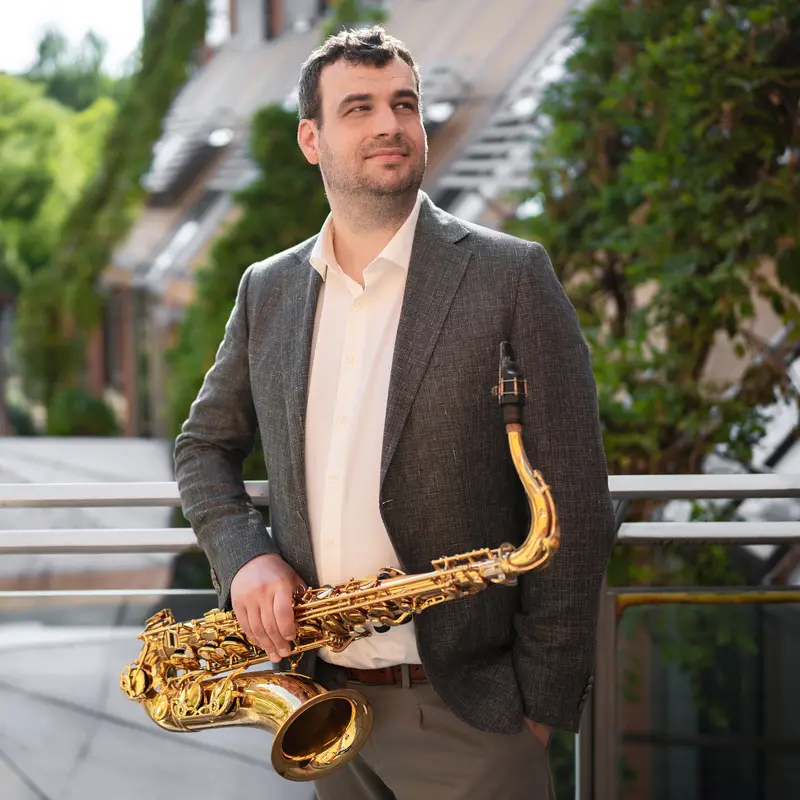
Interview With Tobias Hoffmann
Have you always been interested in music? What is your story and how did you start making music?
My interest in music was sparked mainly by two bands. Firstly, I always played in my school’s big band. That’s where I really felt the sound of such a large band for the first time and experienced what it’s like to play together with others in a large sound collective.
On the other hand, the jazz combo at the municipal music school and its director were a major reason why I became interested in jazz. He exposed us to many classic jazz recordings, and through him I began to learn standards and pieces and to study transcription. At the same time, there were a few like-minded people in the band at that time who were all really getting into jazz, and we would check out music together and share recordings that we thought were great.
Jazz music wasn’t really a thing in my parents’ house. They listened to pop, rock, and some classical music. That’s definitely where my inspiration from rock and pop music comes from. But now my parents go to jazz concerts regularly and have developed their own connection to this music.
I started playing an instrument in early music education on the recorder. After two years, the question arose as to which instrument to learn next. The saxophone was an obvious choice, and I had always been fascinated by how someone could play an instrument with so many keys and mechanisms. I was also drawn to the sound and energy with which some musicians play this instrument. At first, I was quite motivated and practiced regularly. However, I then lost motivation and wanted to stop playing again and again. Sports and other leisure activities were more important to me at the time. Until I joined the jazz combo at the municipal music school. There I met my first important mentor, who taught me a lot and introduced me to a wide variety of jazz music. We were also a clique of like-minded young people who discovered music together. That made a big difference. It was there that I discovered my passion for jazz music and rediscovered my motivation to practice and play the instrument. I think that making music, and jazz music in particular, is a social art form.
What are you working on now? Any future releases we can look forward to?
I am currently working on a composition for a classical singer with very special instrumentation. This is a unique opportunity for me because it allows me to break out of my jazz habits and write for instruments that I don’t normally write for, such as the harp.
I am also working on some arrangements for the Bulgarian master drummer Bobby Petrov. He combines jazz influences with traditional Bulgarian folklore in his music. I’m really looking forward to immersing myself in this music and writing big band arrangements for it.
In addition, I’m working on new music for my own jazz orchestra. I’m organizing a recording session in 2026, where we will record our third CD.
What Is Your Ultimate Goal In The Music Industry?
I have two main goals. On the one hand, I want to collaborate with other musicians and create music together with them, either as a composer/arranger or as a musician. On the other hand, I want to continue writing my own music for my bands and projects and receive commissions to compose for other ensembles.
What Has Been The Biggest Challenge In Your Career Thus Far?
One of my biggest challenges so far has been putting together my own jazz orchestra. In many ways, this was a truly enormous but also rewarding undertaking. I am glad that I managed to do it and have been working on this project since 2021.
How do you go about writing a song? Do you have a melody in your head and then write the other music for it or what’s Your typical songwriting process?
I don’t have a specific way of arranging or composing for a large ensemble or other ensembles. Since I have decided to write for the instruments available in my orchestra and for the individual musicians, I naturally know quite precisely for whom and what I am writing. My compositions can start from any musical point, be it a melodic idea, a rhythm or pattern, a harmony, or an orchestration that piques my curiosity. I think in recent years, most of my compositions have started from a melodic idea or exercise. While studying with Ed Partyka, I worked a lot with Bob Brookmeyer’s composition exercises. As a student of Brookmeyer, Ed knows these very well, of course, and has a great approach for me. These exercises have become more than just exercises for me. They have fundamentally changed my thinking about the composition process and have become a kind of game changer for me in the composition process.
It is also important to me that my music exhibits a certain diversity of grooves, styles, timbres, etc. I learned this in an impressive way from Michael Abene, who repeatedly pointed out weaknesses or repetitions in compositions. An important aspect of my compositional process is time. I like to take my time when composing. I often enjoy being able to view my ideas critically from a distance and readjust them. If I can, I leave “finished” pieces alone for a while and come back to them later to revise myself and my own work until I have come as close as possible to the musical core or core message of my composition.
How do you feel the Internet has impacted the music business?
The Internet has changed the music business like probably no other innovation before. It not only changed how we consume music and the financial value of it. Both are developments which are in a lot of ways negative for musicians. But it opened up lots of new possibilities as well. We can check out performances and recordings from all over the world easily, I can connect with musicians from all over the globe and YouTube kind of became the world library for music and videos. I personally perceive the internet as a good thing and it can help the musicians and institutions in the music market. But of course, every innovation will also create new challenges which we need to deal with.
List some famous musicians currently on your playlist?
At the moment, I am very interested in classical music and music from the 20th century. My playlist currently includes musicians and composers such as John Adams, Erich Wolfgang Korngold, Igor Stravinsky, Benjamin Britten, and Witold Lutoslawski.
But of course, I also listen to a lot of jazz composers and arrangers and their bands, such as Miho Hazama and Darcy James Argue.
I also listen to a lot of music by Jim McNeely, who sadly passed away recently.
What Did You Do Before You Started Making Music?
Music was the first job I had after high school. So, I didn’t have a career in any other field.
Would you have any advice for young people wanting to follow in your footsteps?
I think one of the most important pieces of advice is to be persistent and not give up, no matter what happens and whatever situation you find yourself in. And I would also encourage everyone to remain open to opportunities that come your way, even if they don’t seem to fit in with your plans at first glance. But sometimes it’s precisely these opportunities that help you grow as a musician.
If you could change anything about the music industry, what would it be?
I don’t know if this is really a thing in the industry, but I want to introduce people and listeners to different styles of music and at least make them aware of them. If they then decide that they don’t like a particular style or genre, that’s perfectly fine, but maybe they’ll discover something they like that they didn’t know about before.
How do you feel about originality?
Originality is important. Above all, I believe that we humans are inherently different and unique. But I think that originality in music is something you have to work on, and for most musicians, it comes with time. Most of our individual voices as musicians develop over time and through refining the things we learn. And above all, through being critical of ourselves.
Is there anything else we should know about you? or Something that you would like to add?
I would like to thank the musicians and everyone who has contributed to my projects. It means a lot to me that so many first-class musicians have invested so much time and energy in someone else’s music. I don’t take this for granted, because without them, this music would never exist.
Links to Where Your Music Can be Purchased:
galileomusic.de/interpret/16260/interpret.aspx?interpretid=16260